A New Serenity
March 7, 2023Dana Oberson, an Israeli-based leading architect, specializing in the design of projects on various scales. From luxury villas and apartments, private and public commercial spaces, offices to hotels and resorts in Israel and worldwide. Oberson, a Bezalel Art Academy graduate, previously an architecture lecturer at Tel Aviv University, and currently lectures at Ariel University. Founded Dana Oberson Architects Studio in 2002. The studio maintains a holistic approach to all planning components, from environmental and landscaping aspects through the complex understanding of architectural spaces and the unique perspective to furniture, lighting, interior, and product design. The merger and union process stems from an evolving dialogue with the client and a deep understanding of their needs and desires, which generate a unique and rich, detailed, and customized design.
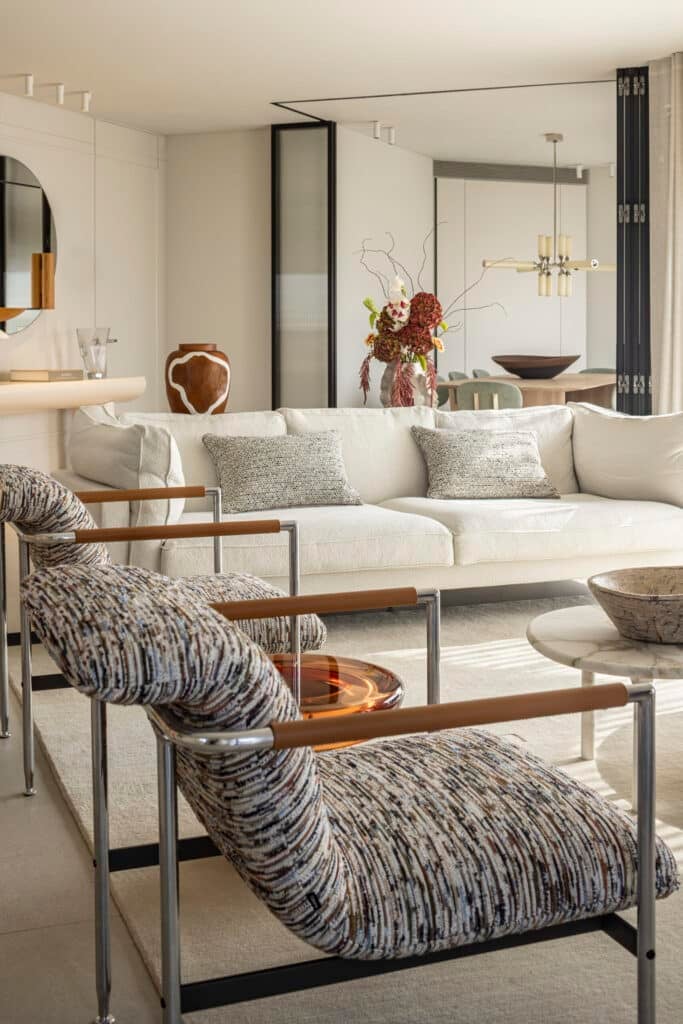
Dana Oberson Architects Studio has recently completed a new project in the marina complex located on the beach of Herzliya. The owners chose the apartment because of its proximity to the sea and wanted to preserve the feeling of space and tranquility it brings. The program features defined public and private areas that consist of open space with a living room, kitchen, and dining area. The private area has a master bedroom, two bathrooms, and a study used as a grandchildren’s room.
The apartment overlooks the horizon and the sea. “We wanted to preserve the sense of serenity in the design, to bring that spirit into the interior,” says architect Dana Oberson. The floor in the apartment is light sand-shaded Rezina which is reminiscent of sea sand and spread throughout the space. The ceiling is also quiet and minimalist. The decorative glass light fixture above the kitchen island is reminiscent of the transparency of the water and allows the continuity of the view. “The kitchen island is like the rock in the sand,” Oberson says. The island surface and all the facades are covered with stormy gray marble that blends with the kitchen fronts. These are made of graphite-colored aluminum along with the faded driftwood facade and stainless steel. “The aim was to create a balance between the natural, calm, and transparent materials and the dominant and dark materials that sit in the space and anchor it. You can feel the power of the sea when you look at the stone, or a tree washed for years by water that gave it its character.”
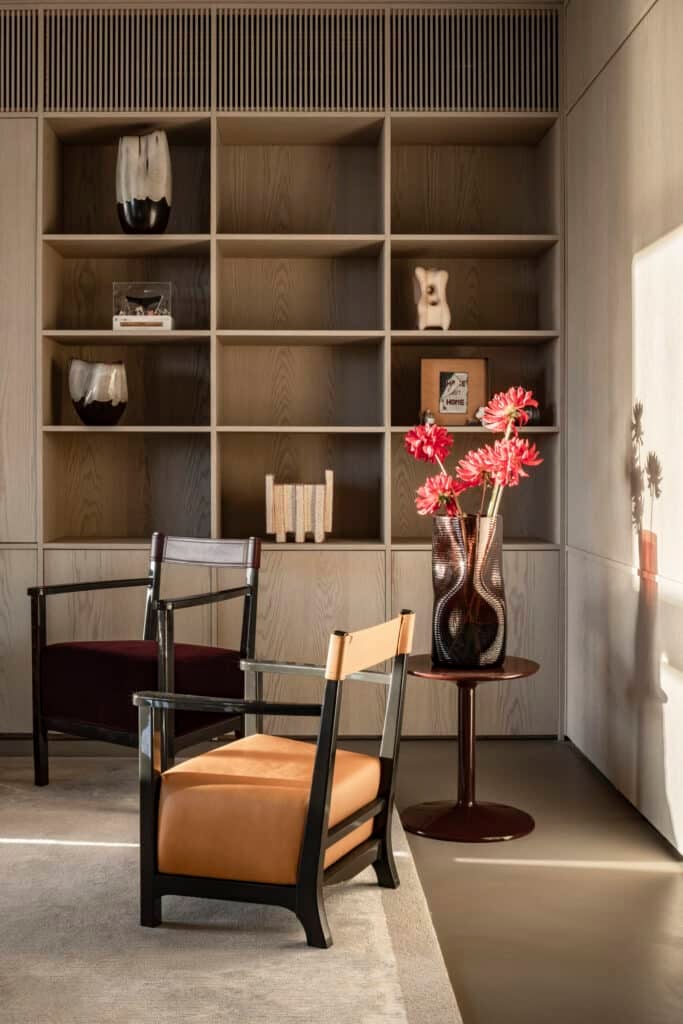
Transparency and simplicity were the design vision for the living room library. The pursuit of transparency has led to a collaboration with SANTAMBROGIO Studio from Milan, specializing in the creation of glass furniture and spaces. “I call it the continuity of nothingness,” Oberson says. The use of driftwood facades was repeated in the bathrooms and study facades. “Since this is a room used by the homeowners for work and for hosting their grandchildren, a closeable study was necessary. We designed a sliding wooden door that moves on a rail and allows the two functions to co-exist.
The art in the apartment has been selected from Zemack Gallery for Contemporary Art. “Combining art always strengthens the design idea and connects to space inseparably. I was looking for art that expresses the silence in a powerful and turbulent situation, like at sea, showing how nature is consistent and determined. “Yigal Ozeri’s work was chosen for the public space and reflected the power of the sea along with its serenity.”
The decided stillness and tranquillity which abounds in her current work provides a stark contrast to her earlier focus on the moving image and the stories of young parents struggling with the hustle and bustle of London’s public transport. Marie prefers to work from photographs than painting the urban landscape from life. The reasons for this are partly practical: “The faff of carrying equipment, finding a subject, setting up a mobile studio, interacting with walkers, dealing with the weather… I find it hard to embrace these challenges.” The process of photographing first, then painting in the quiet of her studio, “music in my ears, without disturbances,” is important to her process. Working from the already-framed view of her photographs, “reality is simplified, and perspectives become my own,” she explains. The shift away from narrative in her recent work, avoiding the depiction of human interactions in her cityscapes allows her to meditate more carefully on colours and shapes, or the particular play of light at a certain time of day. “My intention is to focus on the physical environment, what I see and perceive of it internally, rather than on interpreting or offering a narrative about the people within it.”
Photo: Courtesy of Matchesfashion
Marie’s use of colour is an element of her work for which she is consistently praised. She feels at ease with a restricted colour palette and will often make a single hue the focus of a painting. It is not a surprise, then, that Marie has spent time experimenting with colour through purely abstract compositions: “I would create a set of lines on a canvas and fill them with colour, trying to achieve a feeling, harmony or dissonance.” She adds that this abstract work forms a kind of “research” for the composition of her cityscapes. When Marie looks at the architecture of south London, she is fascinated by the “lack of ornamentation” and “brutal necessity” and of functional architecture like bridges and train lines. By picking out subtle colour combinations and crisp lines hiding in the urban sprawl, she emphasises the quiet elegance of structures which often stand as “unseen, unloved, marks of modern society and its development.”